

Why the smartest creators never rely on a single offer
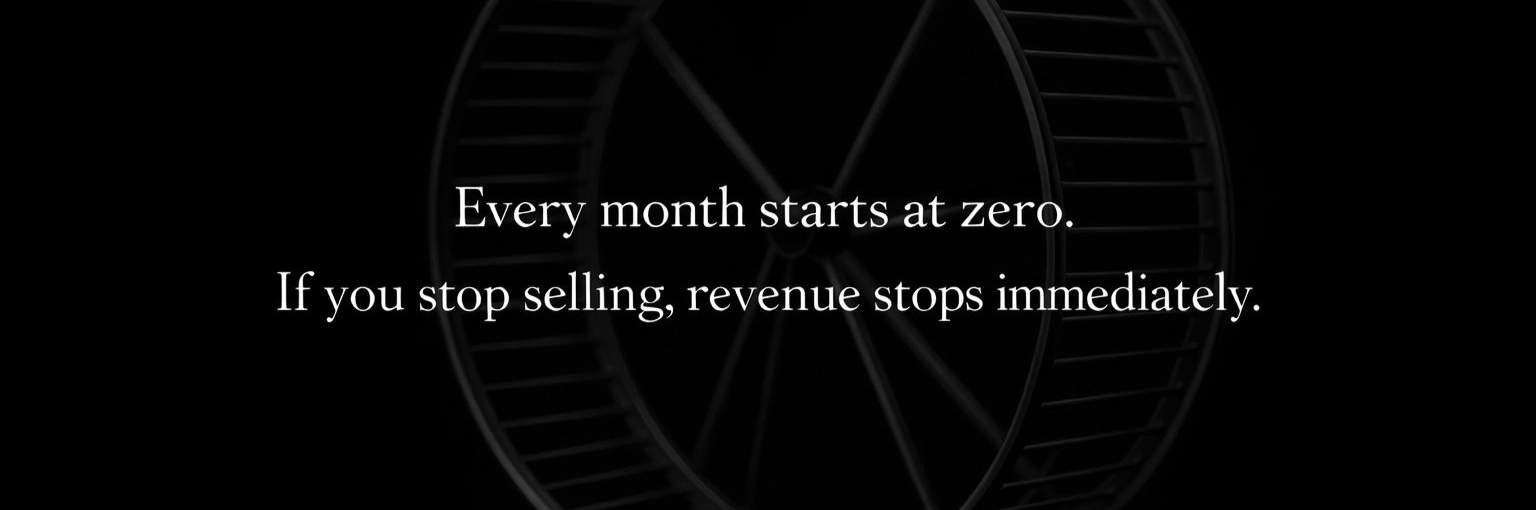
Every month starts at zero.
If you stop selling, revenue stops immediately.
If that sentence makes you uneasy, it is because it is describing your business with uncomfortable accuracy.
High-ticket products have become the default business model for many coaches, especially those without a large enough audience to run a traditional value ladder that starts with low-ticket tripwire offers.
And for good reason.
Selling premium offers lets you work with a smaller, more committed group of clients. You can move fast without a massive social following. You position yourself as an expert in a narrow niche. You build deeper relationships with your clients.
For many solopreneurs, this feels like the perfect business.
Until it doesn’t.
The hidden trap of the high-ticket-only model
Most high-ticket creators start with one-off offers.
Premium coaching. Specialized programs. Exclusive consulting.
The offer is strong. The transformation is real. The money comes in quickly.
Then reality kicks in.
The business becomes dependent on constant closing. There is no margin for pause. Take your foot off the gas and income drops off a cliff.
Creators go on holiday, come back refreshed, and realize something unsettling. There is no recurring income waiting for them. No base layer of stability. Just another month starting at zero.
Welcome to the hamster wheel.
This is where the frantic burnout calls begin.
You can make great money, but you cannot step away without consequences.
Why the down-sell changes everything
The solution is not to abandon high-ticket offers. High-ticket is powerful.
The solution is to stop relying on a single offer.
A down-sell is often misunderstood as a cheaper fallback. Something you offer when a prospect cannot afford your main program. But essentially the same business model, just priced lower.
That is NOT how the top coaches use it.
The highest-performing coaches and creators design a structured range of offers at different price points, each with clearly defined levels of access, support, and service.
The top tier might be $5,000 or more. Below that, mid-ticket programs, some one-off, most recurring quarterly. Below that, a recurring monthly subscription. Below that, a recurring weekly option. Anything recurring is generally lumped together in an industry term MRR (monthly recurring revenue), even if it is actually billed as weekly or quarterly.
As long as it recurs, your business strengthens.
In many cases, you may have as many as eight or ten core price points in total.
None of them are accessible from the homepage. Some are hidden entirely from public view. Most are used strategically. Many exist as side-door pages, discoverable by AI agents, SEO, and shared intentionally as low-friction on-ramps.
How close rates jump to 80 to 95 percent
This is where things get interesting.
Creators who implement a structured down-sell properly often see close rates jump from 30 to 50 percent all the way up to 80 or even 95 percent.
Why?
Because the sales conversation stops being binary.
It is no longer yes or no to a single price.
Instead, the conversation becomes diagnostic. Budget. Readiness. Desired level of support. When a $5,000 offer is outside the prospect’s comfort zone, the conversation does not end. It simply moves to the next appropriate option.
The prospect still becomes a customer. Just at the right level for them.
That is the real power of the down-sell.
More yeses. Higher lifetime value. Less pressure on every single call.
The real bottleneck has always been delivery
Most creators understand this in theory. Very few execute it well.
The reason is simple.
Multiple offers usually mean more complexity. More admin. More prep. More weekly check-ins. More cognitive load for the coach. This almost always ends in burnout.
This is where solopreneurs hit a ceiling.
Without hiring other coaches, it is impossible to scale personalized service if every client requires manual effort every week. And once hiring begins, quality issues, sick days, inconsistent delivery, and unhappy clients quickly follow.
Over time, your personal brand erodes. Friends and hires peel off. Processes walk out the door. Clients follow. Relationships end badly. The business stalls and never truly scales.
We see this scenario repeat so frequently in the industry that it is honestly heartbreaking.
Much of the advice given on how to “scale” using these hiring strategies and shallow automations is not designed to help coaches long-term. It is designed to maximize profitability for the consultants selling that advice.
Calling it what it is matters.
This is exactly the problem we built MacroActive to solve.
How MacroActive makes the down-sell scalable
MacroActive allows creators to deliver high-touch value across multiple price tiers, low, medium and high ticket, without burning out and without hiring and managing large teams.
With MacroActive’s PensiveAI™ Check-In tools, the weekly coaching workflow changes completely.
Imagine having everything you need to deliver a world-class check-in instantly in front of you. What used to take around 15 minutes of preparation per client now takes about 30 seconds.
You still deliver personalized feedback. You still show up informed. But the heavy lifting happens automatically in the background.
This unlocks an entirely new operating model.
You can confidently offer high-ticket, mid-ticket, and subscription programs at the same time, knowing they are easy to administer and consistent to deliver.
You are no longer forced to choose between exclusivity and scale.
👉 If you’ve max’d out your available hours in a day with current high ticket clients, let us know and we’ll add you to MacroActive’s PensiveAI™ Check-In beta.
The real advantage of the down-sell
The down-sell is not about making less money.
It is about building a business that lasts.
It gives prospects more ways to say yes.
It creates recurring revenue beneath your high-ticket wins.
A base of always-on income that covers your costs and gives you leverage.
That leverage allows you to outspend competitors to acquire the very best high-ticket clients.
Most importantly, it lets you step off the hamster wheel without sacrificing the premium positioning you worked so hard to build.
High-ticket opens the door.
The down-sell builds the foundation.
And the creators who understand this are the ones consistently winning at scale, years later.